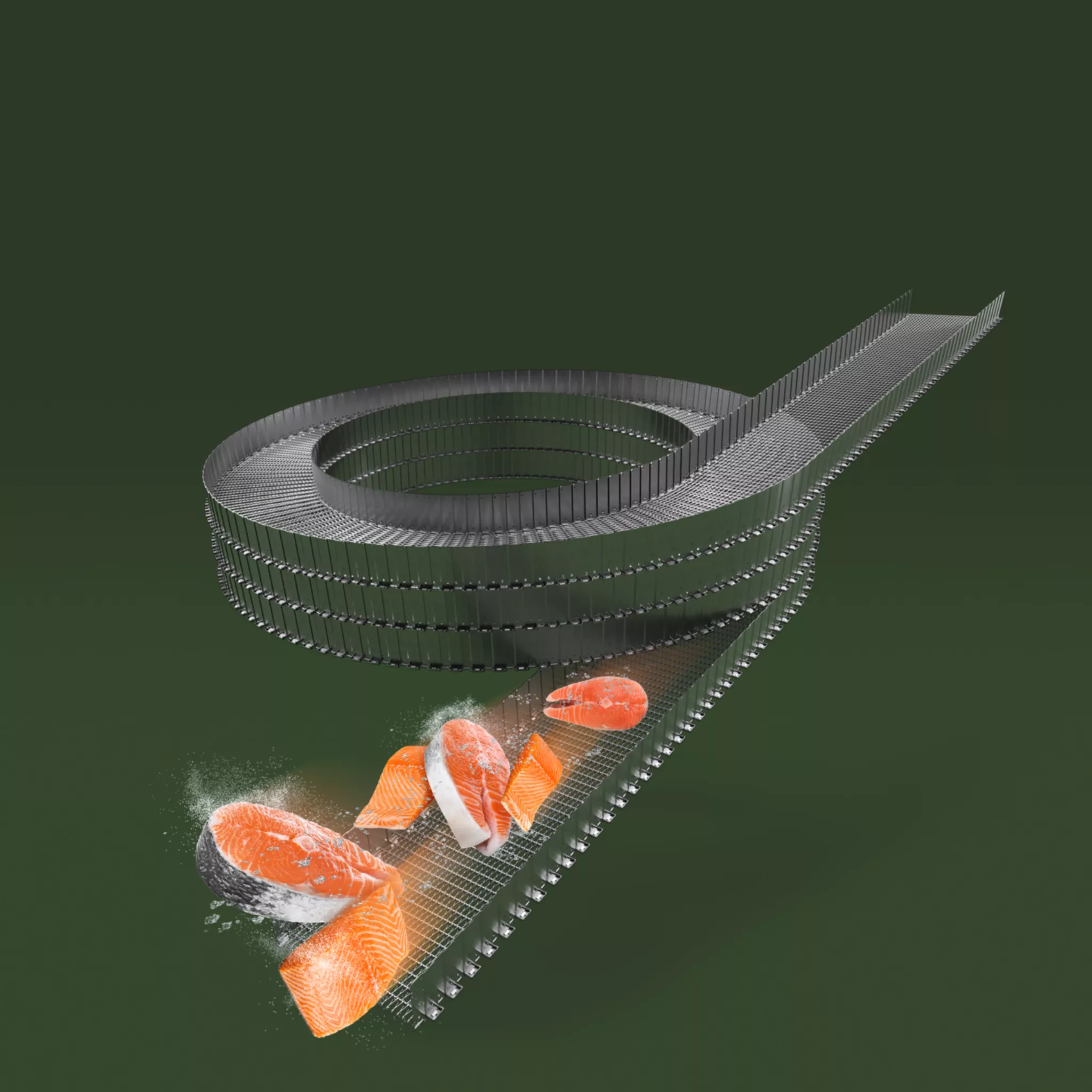
A chicken fillet moving through a breading line has different conveying requirements from a salmon portion being cooled or a product travelling through a spiral freezer. The belt needs to suit the product, the process and the layout of the installation.
Twentebelt supplies metal conveyor belts for processing products such as minced meat, pork, sausages, chicken fillets, chicken wings, chicken nuggets, salmon, tuna and shrimp. Applications include breading, baking, frying, cooking, cooling, freezing, pasteurizing and packaging.
Choosing a conveyor belt for meat, poultry and fish processing
The product and process determine what the belt needs to do. Product dimensions and weight inform the level of support required. The process may call for an open surface that allows airflow or drainage, a small product contact area, or a flat and stable conveying surface.
The conveyor system is part of the specification too. Drive arrangement, belt tracking, transfer points and available space all affect which belt design will fit the production line.
Product support, airflow and drainage
An open belt structure can allow air or liquids to pass through the conveying surface. This is useful in processes such as frying, cooling, drying and coating. The opening size and belt design still need to provide suitable support for the product.
Where products need a flat, stable surface, an eyelink belt may be appropriate. Where a small contact area and an open structure are important, a wire mesh belt may be considered. The right choice depends on the product and the process.
Metal conveyor belts for different processes
Twentebelt’s range includes wire mesh, eyelink, balanced weave, TwenteFlex and TwenteSideFlex belts. Each type suits different applications and system layouts.
Wire mesh belts for breading, coating and frying
Wire mesh belts are used for breading, enrobing, baking, frying, heating and packaging. Their open structure provides a small product contact area and allows airflow and drainage.
Belt pitch, wire diameter, mesh length and edge finish can be specified to suit the product and conveyor. For smaller products, the mesh opening should provide the support they need during transfer.
Eyelink belts for stable product support
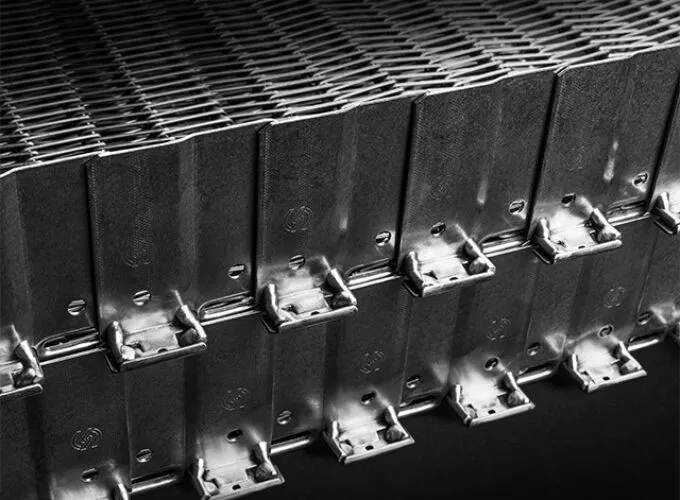
Eyelink belts provide a flat, stable conveying surface. They are used in applications such as baking, battering, cooling, drying, freezing and pasteurizing. Their construction also allows air and liquids to pass through.
The belt configuration should reflect the product, load and process. Product support and permeability need to be considered together.
TwenteFlex spiral belts for cooking, cooling and freezing
TwenteFlex spiral belts are used in spiral systems for processes including cooking, cooling, freezing, pasteurizing and steaming. Their design has no welded connections and can be configured for low-tension or direct-drive systems.
The suitable configuration depends on the spiral system, operating conditions and drive arrangement.
TwenteSideFlex for spiral and oval systems
TwenteSideFlex is designed for spiral and oval systems. It is used for cooking, cooling, freezing, pasteurizing and steaming. Its external direct-drive design operates without a central drum, giving machine builders another option when planning the system layout.
Balanced weave belts for varied process requirements
Balanced weave belts are used for baking, freezing, frying, heating and packaging. Different configurations support different product and process requirements. The design can also accommodate small-radius transfers where the system calls for them.
Specifying a conveyor belt for your production line
To assess a belt for a new or existing installation, Twentebelt needs details about the product, process and conveyor system. Useful information includes product dimensions and weight, belt speed, load, drive arrangement and transfer points. For a replacement belt, existing belt specifications and installation drawings can help assess compatibility.
Twentebelt works with machine builders and end users on belt selection, design and commissioning. Contact Twentebelt to discuss your application.
 Eyelink belt Robust, versatile, and suitable for numerous food processing applications.





 Eyelink belt
 Wire mesh belt
 Balanced weave belt
 TwenteFlex spiral belt
 TwenteSideFlex
 TwenteStack™
 Custom conveyor belt
 Documents