A belt for every stage of potato processing
The requirements of a washing belt differ from those of a fryer or freezer belt. The right choice depends on the product’s dimensions and shape, required capacity, operating temperature, belt speed and conveyor layout. Get these wrong at one stage and the line compensates for it at every stage after, usually at the cost of throughput or product quality.
Washing, blanching and drying
During washing and blanching, the belt must support the product while allowing water and process liquids to pass through and drain away. The opening size has to suit the product: small or irregular pieces, like potato cubes, need enough support to stay on the belt without blocking drainage.
For drying, airflow through the belt becomes the deciding factor. The suitable construction depends on the product, required throughput and installation — read more about Twentebelt’s drying applications.
Frying, baking and seasoning
For frying and baking, belt construction has to match the process temperature, product load and conveying system. Open area and product contact decide how the product is supported and how evenly heat reaches it. Transfer points and drive arrangement are as much a part of the specification as the belt material.
Seasoning and finishing need dependable product handling after a coating or seasoning layer has gone on — a belt that jostles or drags the product at this stage shows up as a defect in the finished piece. Twentebelt offers several belt designs for these stages, each with different open area and product contact characteristics.
Cooling and freezing
Cooling and freezing lines need a belt suited to the system layout, product and required process time. An open belt structure allows airflow through the conveying surface. Spiral and self-stacking systems also need a belt that matches the system’s drive and configuration — fitting the wrong belt here means fighting the system’s mechanics for the belt’s working life.
Twentebelt offers TwenteFlex spiral belts, TwenteSideFlex and TwenteStack™ for spiral and self-stacking applications.
Choosing a conveyor belt for potato processing
Twentebelt’s range for potato processing includes eyelink belts, TwenteFlex spiral belts, TwenteSideFlex, balanced weave belts, wire mesh belts and TwenteStack™. Each design has different characteristics. The right solution depends on your product, process stage and equipment — not on which belt is already on the line.
Eyelink belts for robust, stable conveying
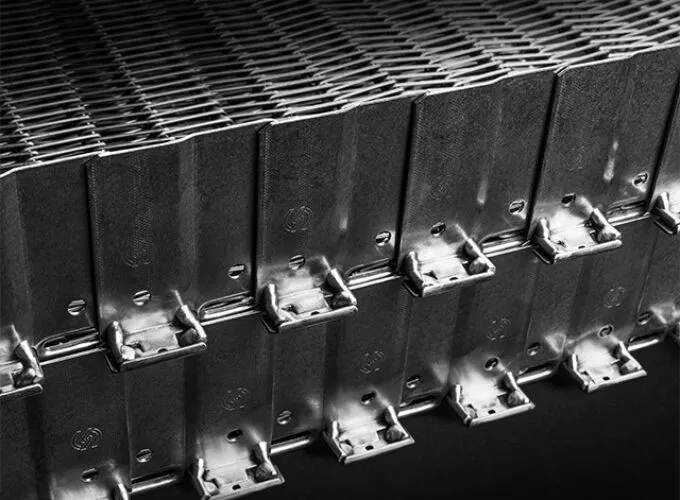
Eyelink belts have a flat, stable conveying surface and a robust construction that gives even support to heavy, delicate or unstable pieces — relevant for product like croquettes or rösti that can’t tolerate marking. Their open structure allows air and liquids to pass through. Used in baking, battering, cooling, drying, freezing and pasteurising, with different opening sizes available to match the product and process.
TwenteFlex spiral belts for spiral systems
TwenteFlex is a spiral conveyor belt built without welded connections, removing one of the most common failure points in spiral systems — the kind of unplanned downtime a continuously running freezing line can’t absorb. Suited to low-tension and inside direct drive systems, and used in cooling, freezing, cooking, pasteurising, proofing and steaming.
TwenteSideFlex for spiral and oval layouts
TwenteSideFlex is designed for spiral or oval systems without a central drum driving the belt. Removing the drum frees up footprint and simplifies cleaning access, which matters when a cooling or freezing spiral has to fit an existing layout. Used in cooking, cooling, freezing, pasteurising, proofing and steaming.
Balanced weave belts for versatile processing
Balanced weave belts come in a wide range of configurations, with positive or friction drive depending on the design. Used in baking, freezing, frying, heating and packaging — a fit for potato lines running several of these stages on connected equipment rather than one belt type per stage.
Wire mesh belts for airflow and drainage
Wire mesh belts combine a high strength-to-weight ratio with minimal product contact. The open construction supports airflow and drainage, which matters where product marking has to stay minimal. Used in baking, breading, enrobing, frying, heating and packaging.
TwenteStack™ for self-stacking systems
TwenteStack™ is a self-stacking metal conveyor belt for new and existing self-stacking spiral systems. Each tier stacks directly onto the tier below, letting long belt lengths run through a compact footprint — relevant for potato processors running long freezing residence times without the floor space for a conventional spiral. Used in cooling and freezing.
Specify a belt around your potato process
Whether you’re developing a new line or replacing an existing belt, start with the product and the operating conditions. Useful details include product dimensions and weight, required throughput, process stage and temperature, belt speed and dimensions, drive arrangement and available installation space.
For a replacement, existing belt specifications and drive details help assess compatibility. Drawings or a belt sample provide further information. We’ve been specifying belts this way since 1913 — matching the belt to the product and process before it’s built, not correcting it after installation.
Contact Twentebelt to discuss your potato processing application or request a quotation.
 Eyelink belt Robust, versatile, and suitable for numerous food processing applications.




 Eyelink belt
 Wire mesh belt
 Balanced weave belt
 TwenteFlex spiral belt
 TwenteSideFlex
 TwenteStack™
 Custom conveyor belt
 Documents